


Learn To Read The Quran In 30 Days
Interactive 30-day path to build Quranic reading foundations, from Arabic letters to real words. Free.
-
Spaced review
When you revisit earlier lessons instead of learning once and moving on, that links to the spacing effect, spaced review helps memory last longer than cramming.
-
Retrieval practice
Short quizzes are not just tests. They make you pull information from memory, which cognitive psychology links to stronger learning and longer recall.
-
Listen, repeat, recognise
For Quran reading, hearing the sound, repeating it, and recognising it again connects each Arabic letter and vowel mark with the correct pronunciation.
-
Daily habit building
The 30-day structure helps you avoid overwhelm. You are not expected to master everything at once, you build consistency through small daily progress.
-
Progress you can see
When you can see what you have completed and what needs review, you feel less lost. That visibility supports motivation and confidence as you learn.
About This Course
Maybe you have carried this wish quietly for years. To open the Mushaf and recognise the words of Allah yourself, not through a translation, but with your own eyes and your own voice.
Life gets busy. You tell yourself you will start tomorrow, or next Ramadan, or when you have more time. You are not alone in that. But the longing does not really go away.
Thirty days from now, that longing can become something real. Not perfection. Not fluency overnight. But the first true step: letters becoming familiar, sounds becoming yours, and the page no longer feeling like a locked door.
This course was built for that moment, when you are finally ready to begin, and you need a path that is gentle, clear, and worth showing up for every day.
Is this for you?
- You are starting from zero, or returning after years away, and you do not want to feel embarrassed for beginning again.
- You want to recognise the words of Allah, not only hear or read a translation of their meaning.
- You can give ten honest minutes a day to something that matters more than scrolling or putting it off again.
- You are tired of random videos and charts that leave you unsure whether you are learning the right thing next.
Your 30-day goal
Picture yourself at the end of this month: the alphabet no longer a blur, the page starting to speak back to you.
- Know all 28 Arabic letters by sight and sound, not memorised in panic, but absorbed step by step.
- Pronounce each letter with care, the way it deserves when it carries the word of Allah.
- Read vowels, joined letters, still letters, doubled letters, and longer sounds, the building blocks of every ayah.
- Recognise real Quranic words and the signs written around them.
- Understand basic pause marks, so when you stop, you stop with intention, not confusion.
The method
We designed this the way you actually learn, not the way passive apps pretend you do.
- Listen first, so you never have to guess a sacred sound.
- Practise daily, small sessions that respect your life, not consume it.
- Move step by step, so guilt is replaced by steady progress you can feel.
- Test yourself, gentle checks that build confidence, not fear of failing.
Why this system exists
I know what it feels like to want this deeply and still not know where to start. What changed everything for me was not talent or endless free time, it was structure, someone showing me the next step, and permission to go slowly.
That is what this course offers you: no shame for starting from the beginning, no confusion about what comes next, and no pressure to be perfect on day one.
Just one letter. One lesson. One sincere effort at a time, until the words you have always wanted to read are finally, quietly, yours.
Course Curriculum
Ten interactive modules, listen, tap, practise, and unlock the next step only when you are ready.
-
Start
Welcome & your 30-day path
See how each session works, no guessing, no overwhelm.
-
Start
How this course works
Interactive steps, audio first, quizzes when you are ready.
-
Listen
Alphabet soundboard
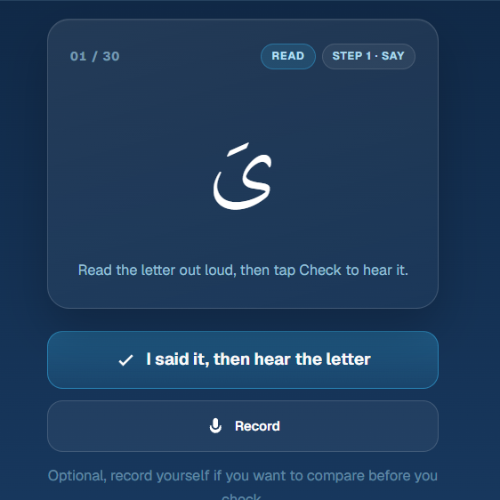
Tap any of the 28 letters and hear it pronounced clearly.
-
Groups11 pronunciation families
Letters taught in memorable groups, not a random A, Z list.
- Alif The anchor letter every beginner meets first
- Boat family Ba · Ta · Tha, same shape, three distinct sounds
- Gymnasium family Jim · Ha · Kha, deep throat letters
- Duo family Dal · Dhal, tell the twins apart
- Roller family Ra · Zay, rolling vs buzzing
- Teeth family Sin · Shin, whisper vs hush
- Heavy family Sad · Dad · Ta · Dha, emphatic letters
- Earpiece family Ayn · Ghayn, from the depth of the throat
- Fa, Qaf & Kaf Three letters learners often mix up
- Lam, Meem & Noon The flowing connectors in countless words
- The helpers Ha · Waw · Ya, long vowels and more
-
Game
Find the Letter
A quick game to make recognition stick.
-
Quiz
Alphabet mastery check
Pass this and Module 2 unlocks, proof you are ready.
-
Start
What harakat do
Why Arabic needs those small marks above and below letters.
-
Listen
Vowel soundboard
Fatha · Kasra · Damma, hear each one on real letters.
-
Practice
11 practice rounds
Short, guided sets so vowels become automatic.
-
Checkpoint
Readiness checkpoint
A brief pause to confirm vowels feel familiar.
-
Quiz
Harakat quiz
Show you can read vowelled letters before moving on.
-
Start
Why similar letters trip beginners
Spot the tiny differences that change the whole word.
-
Listen
Six comparison sets
S/Sh · J/Z/Th · H pair · Kh/Gh · D pair · K/Q, side by side.
-
Practice
Discrimination practice
Train your eye and ear until pairs feel obvious.
-
Quiz
Similar letters quiz
Pick the right letter under pressure, like real reading.
-
Start
How Arabic connects
Why the same letter changes shape at the start, middle, or end.
-
Listen
Connection guide
Visual map of initial, medial, and final forms.
-
Listen
Connected letters board
Tap joined forms and hear them in context.
-
Practice
Word-building practice
Piece letters together until connections feel natural.
-
Checkpoint
Readiness checkpoint
Confirm joined forms before the next challenge.
-
Game
Form Hunt
Spot the correct letter shape inside a word, fun and focused.
-
Quiz
Connected letters quiz
Read short connected words with confidence.
-
Start
The quiet mark explained
What sukoon means and when you will meet it in the Quran.
-
Practice
Sukoon practice
Guided drills on still, vowel-less letters.
-
Checkpoint
Readiness checkpoint
Make sure sukoon feels clear before tanween.
-
Quiz
Sukoon quiz
Read sukooned letters in short Quranic-style syllables.
-
Start
Double vowel endings
What tanween sounds like and why it matters in recitation.
-
Practice
Tanween practice
Repeat until the three endings feel distinct.
-
Checkpoint
Readiness checkpoint
Lock in tanween before doubled letters.
-
Quiz
Tanween quiz
Identify and read tanween in real word patterns.
-
Start
Doubled letters explained
Why shaddah asks you to hold and stress a letter.
-
Practice
Shaddah practice
Slow, clear reps until doubling feels natural.
-
Checkpoint
Readiness checkpoint
Check shaddah before natural lengthening.
-
Quiz
Shaddah quiz
Read words with shaddah accurately and confidently.
-
Start
Natural lengthening
When to stretch a sound and for how long.
-
Practice
Madd practice
Guided exercises for steady, measured lengthening.
-
Checkpoint
Readiness checkpoint
Confirm madd before stopping rules.
-
Quiz
Madd quiz
Apply madd in short Quranic-style phrases.
-
Start
Rules at a stop
How pronunciation shifts when you break a word.
-
Practice
Four rule sets
Practice each stopping rule until it feels automatic.
-
Start
Waqf symbols decoded
The pause marks you will see on every Mushaf page.
-
Practice
Mark recognition practice
Match each sign to the right action.
-
Quiz
Final course assessment
Your graduation moment, prove you can read with the foundations in place.
Frequently Asked Questions
Common questions before you enrol, straight answers, no jargon.
No. The course assumes zero Arabic. You begin with letters and build step by step with guided audio and interactive practice.
Videos and charts are passive. This course is interactive: you listen, practise, check your answers, and pass short recall checks before advancing, with a fixed path so you always know what comes next.
The reading foundations beginners need across ten modules: letters, vowel marks (harakat), connected letters, quiet letters (sukoon), double vowel endings (tanween), doubled letters (shaddah), held vowels (madd), and pause marks (waqf), with audio and quizzes throughout.
The course applies five research-informed methods: <strong>spaced review</strong> (revisiting lessons helps memory last longer), <strong>retrieval practice</strong> (quizzes strengthen recall), <strong>guided audio</strong> (hear, repeat, and recognise each sound), <strong>daily habit building</strong> (small steps across 30 days), and <strong>visible progress</strong> (see what you have mastered and what needs review).
Yes. The flagship beginner course is free to enrol. Create an account and start the interactive lessons immediately.
Yes. The course is structured across 30 days, but you control the speed. Revisit any lesson or quiz whenever you need more practice.
Yes. Interactive lessons, audio, and quizzes work in your mobile browser, ideal for short daily practice sessions.
Why learners choose this course
Built on spaced review, retrieval practice, guided audio, daily habits, and visible progress, not another passive video course.
-
Spaced review
Revisit to remember longer
When you revisit earlier lessons instead of learning once and moving on, that links to the spacing effect, spaced review helps memory last longer than cramming.
-
Retrieval practice
Quizzes strengthen memory
Short quizzes are not just tests. They make you pull information from memory, which cognitive psychology links to stronger learning and longer recall.
-
Listen, repeat, recognise
Sound meets sight
For Quran reading, hearing the sound, repeating it, and recognising it again connects each Arabic letter and vowel mark with the correct pronunciation.
-
Daily habit building
Small steps, steady progress
The 30-day structure helps you avoid overwhelm. You are not expected to master everything at once, you build consistency through small daily progress.
-
Progress you can see
Confidence through clarity
When you can see what you have completed and what needs review, you feel less lost. That visibility supports motivation and confidence as you learn.
.svg)